Introduction
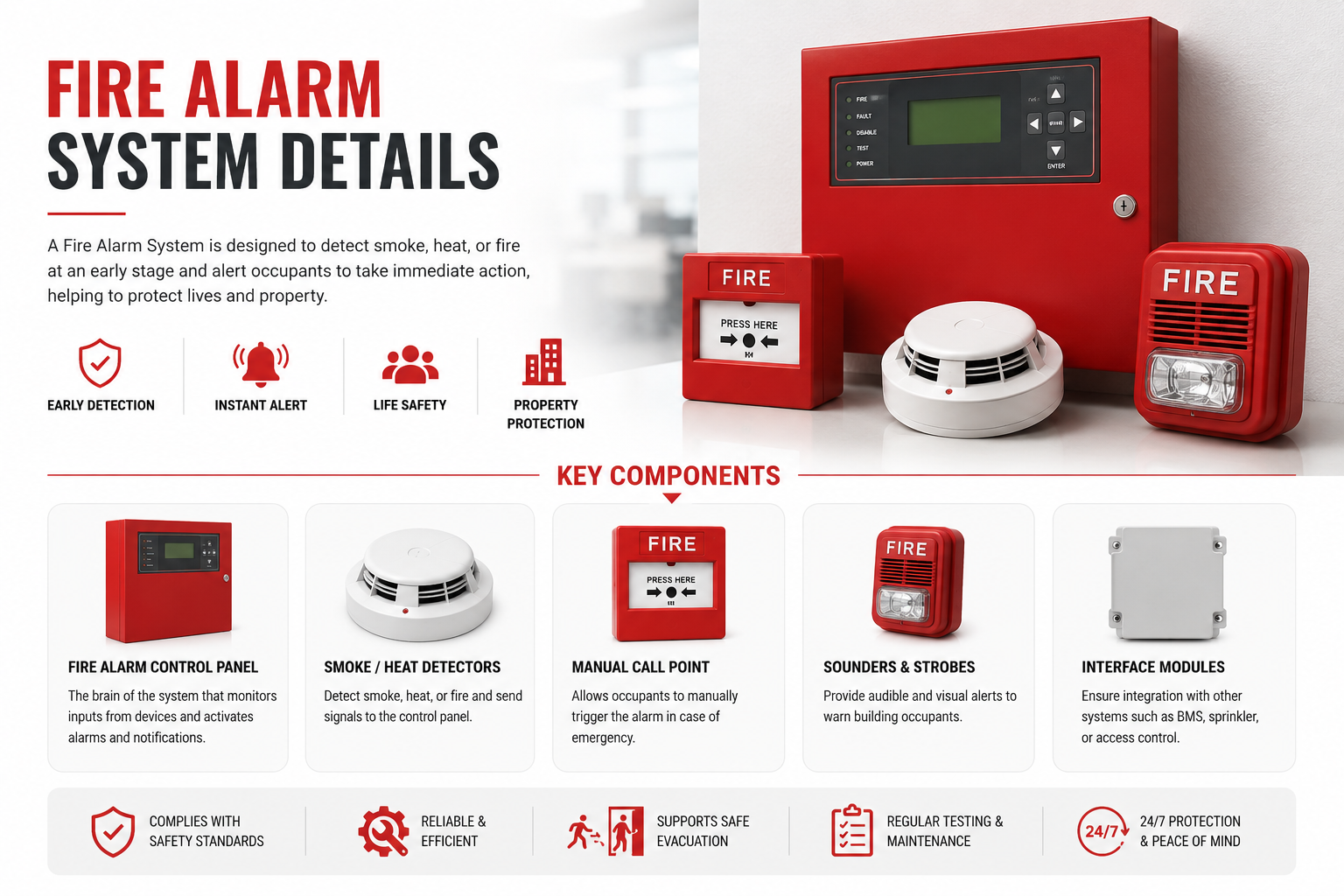
A fire alarm system is one of the most important safety systems used in buildings today. Its main purpose is to detect fire or smoke at an early stage and alert people inside the building so they can evacuate safely.
Fire alarm systems are commonly installed in:
- Hotels
- Offices
- Hospitals
- Shopping malls
- Factories
- Schools
- Residential buildings
This guide explains fire alarm systems in simple English so that even beginners, building owners, technicians, and business owners can easily understand how they work.
What is a Fire Alarm System?
A fire alarm system is an electronic safety system designed to:
- Detect smoke or heat
- Send signals to the control panel
- Activate alarms and warning devices
- Help people evacuate safely
- Reduce fire damage and risk
In simple words:
“A fire alarm system warns people immediately when fire or smoke is detected.”
Main Components of a Fire Alarm System
1. Fire Alarm Control Panel (FACP)
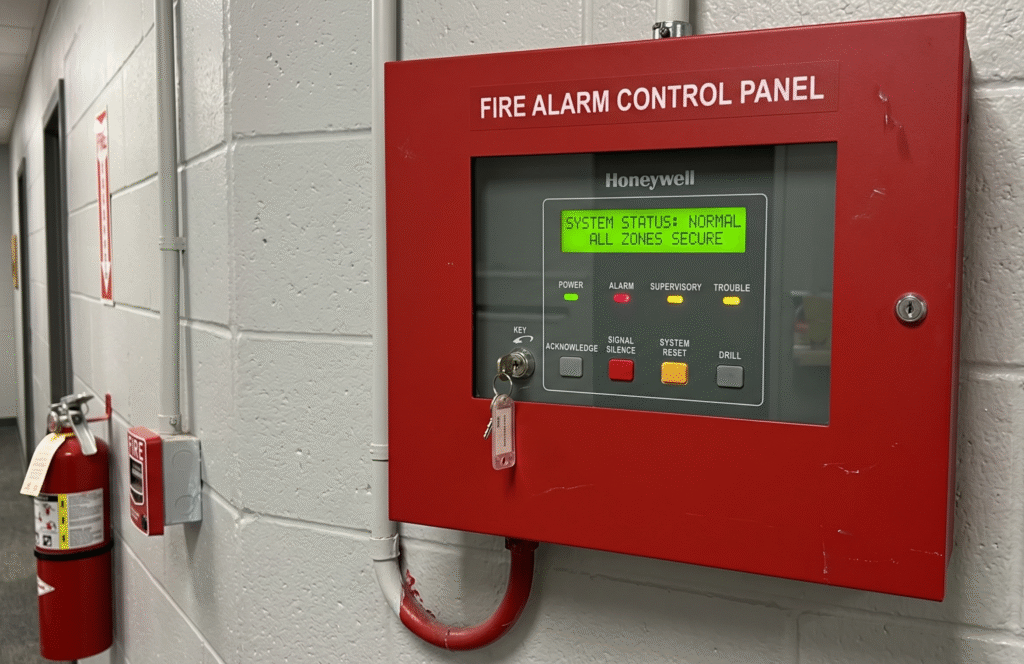
The fire alarm control panel is the “brain” of the entire system.
Main Functions:
- Monitors all detectors and devices
- Receives alarm signals
- Activates hooters and strobes
- Displays fault conditions
- Monitors battery backup
Types:
- Conventional Fire Alarm Panel
- Addressable Fire Alarm Panel
Conventional Fire Alarm Panel
A conventional fire alarm panel is a basic fire alarm system where detectors and devices are divided into different zones. When a fire occurs, the panel identifies only the affected zone, not the exact device location.
Main Components
- Fire Alarm Control Panel
- Smoke Detector
- Heat Detector
- Manual Call Point (MCP)
- Hooter / Sounder
- Response Indicator
- Battery Backup
How It Works
- Devices are connected in separate zones.
- Each floor or area usually has one zone.
- If a detector activates, the panel shows only the zone number, such as
- Zone 1 – Basement
- Zone 2 – Ground Floor
- Zone 3 – Office Area
The exact detector location must be checked physically.
Advantages
✅ Simple installation
✅ Low cost
✅ Easy operation
✅ Good for small buildings
✅ Less programming required
Limitations
❌ Exact device location not available
❌ More wiring required
❌ Difficult troubleshooting in large systems
❌ Limited expansion capability
READ MORE.
Conventional vs Addressable
| Feature | Conventional | Addressable |
|---|---|---|
| Detection | Zone wise | Device wise |
| Cost | Lower | Higher |
| Wiring | More | Less |
| Troubleshooting | Moderate | Easy |
| Building Size | Small | Large |
| Programming | Basic | Advanced |
Common Applications
- Small offices
- Shops
- Schools
- Warehouses
- Small hotels
- Residential buildings
Common Brands
- Honeywell
- Ravel
- Agni
- Bosch
- Eaton
- System Sensor
Simple Wiring Diagram
Zone 1 ---> Smoke Detectors ---> MCP ---> Panel
Zone 2 ---> Heat Detectors ----> MCP ---> Panel
Zone 3 ---> Hooter Circuit ----> Sounders

Panel ---> Battery Backup
Working Principle
When smoke or heat is detected:
- Detector sends signal to panel
- Panel identifies active zone
- Hooter/Sounder activates
- Fire indication LED glows on panel
Typical Zone Example
| Zone | Area |
|---|---|
| Zone 1 | Basement |
| Zone 2 | Ground Floor |
| Zone 3 | First Floor |
| Zone 4 | Electrical Room |
Conventional panels are mainly used where the building area is small and exact detector identification is not necessary.
Addressable Fire Alarm Panel
An Addressable Fire Alarm Panel (FACP / FACU) is an intelligent Fire Alarm Control System in which all devices (smoke detectors, heat detectors, manual call points, modules, sounders) have a unique address. The panel can locate the exact location of the device in alarm or fault condition.
Main Components
- Fire Alarm Control Panel
- Smoke Detector
- Heat Detector
- Manual Call Point (MCP)
- Hooter / Sounder / Strobe
- Monitor Module
- Control Module
- Fault Isolator
- Battery Backup
How It Works
- All devices are connected through an SLC (Signaling Line Circuit/Loop).
- Each device has a unique numerical address.
- The panel continuously communicates (“polls”) with devices.
- If smoke or heat is detected, the panel displays the exact location such as:
- “3rd Floor Corridor Smoke Detector”
- “Electrical Room Heat Detector”
Advantages of Addressable System
✅ Exact fire location identification
✅ Faster troubleshooting
✅ Reduced wiring compared to conventional systems
✅ Supports hundreds of devices on one loop
✅ Easy integration with:
- Sprinkler system
- HVAC shutdown
- Lift recall
- PA/BMS system
- Gas suppression system
Conventional vs Addressable Panel
| Feature | Conventional Panel | Addressable Panel |
|---|---|---|
| Detection | Zone wise | Device-wise |
| Wiring | More | Less |
| Fault Finding | Difficult | Easy |
| Device Identification | No | Yes |
| Programming | Limited | Advanced |
| Suitable For | Small buildings | Large buildings |
Common Brands
- Honeywell
- Notifier
- Siemens
- Edwards
- Simplex
- Bosch
- Ravel
Typical Applications
- Hotels
- Hospitals
- High-rise buildings
- Data centers
- Airports
- Shopping malls
- Industrial plants
A smoke detector senses smoke particles in the air and sends a signal to the panel.
Common Installation Areas:
- Offices
- Hotel rooms
- Corridors
- Server rooms
- Lobbies
Types of Smoke Detectors:
- Photoelectric Smoke Detector
- Ionization Smoke Detector
- Multi-Criteria Detector
3. Heat Detector
Heat detectors activate when the temperature rises above a certain level.
Common Installation Areas:
- Kitchens
- Parking areas
- Generator rooms
- Dusty environments
Heat detectors are preferred where smoke detectors may create false alarms.
4. Manual Call Point (MCP)
A Manual Call Point allows a person to manually activate the fire alarm during an emergency.
Also Known As:
Break Glass Unit
5. Hooter / Siren / Strobe
These devices sound and flash lights in a fire emergency.
Purpose:
- Warn building occupants
- Start emergency evacuation
- Improve emergency response
6. Fire Alarm Cable
Fire alarm cables are used for communication between devices and the control panel.
Common Cable Types:
- 2-Core Cable
- 4-Core Cable
- Shielded Cable
- Fire-Resistant Cable
Features:
- Every device has a unique address
- Exact fire location is displayed
- Best for large buildings
Advantages:
- Faster troubleshooting
- Accurate fire location
- Smart monitoring
Disadvantages:
- Higher installation cost
How a Fire Alarm System Works
Step-by-Step Process
- Smoke or heat is detected
- Detector sends signal to the panel
- Panel processes the alarm
- Hooter and strobe activate
- Occupants evacuate the building
- Emergency response begins
Fire Alarm Installation Guidelines
Basic Rules
Smoke Detector Spacing
- Ceiling mounted
- Typically around 9 meters spacing
Heat Detector Spacing
- Around 7 meters spacing
Manual Call Point Height
- Around 1.4 meters from floor level
Alarm Sound Level
- Must be clearly audible throughout the building
Important Fire Safety Standards
Common international fire safety standards include:
- NFPA
- UL
- FM Global
- NBC
These organizations define fire safety rules and installation requirements.
Fire Alarm System Maintenance
Regular maintenance is essential for proper operation.
Weekly Checks
- Panel status inspection
- Fault indication check
Monthly Checks
- Detector testing
- MCP testing
- Hooter testing
Annual Maintenance
- Full system inspection
- Battery replacement
- Cable inspection
Common Fire Alarm Faults
| Fault Type | Possible Reason |
|---|---|
| Open Circuit | Cable break |
| Short Circuit | Wire contact issue |
| Detector Fault | Dust or device damage |
| Battery Fault | Low backup battery |
| Ground Fault | Earthing problem |
Smoke Detector vs Heat Detector
| Smoke Detector | Heat Detector |
|---|---|
| Detects smoke | Detects temperature rise |
| Faster response | Slower response |
| Suitable for offices | Suitable for kitchens |
| Can create false alarms | Fewer false alarms |
Fire Alarm Integration with Other Systems
Modern fire alarm systems can integrate with:
- Sprinkler Systems
- HVAC Shutdown
- Lift Recall
- Access Control Systems
- Public Address Systems
- Building Management Systems (BMS)
Benefits of Fire Alarm Systems
Advantages
✅ Early fire detection
✅ Improved life safety
✅ Reduced property damage
✅ Faster evacuation
✅ Insurance compliance
✅ Better building protection
Conclusion
A fire alarm system is a critical life safety system for every building. Proper installation, testing, and maintenance help protect both people and property during fire emergencies.
Whether you are a beginner, technician, business owner, or building manager, understanding the basics of fire alarm systems is extremely important in today’s world.
Modern intelligent and addressable systems now provide faster detection, accurate monitoring, and better fire protection than ever before.
Frequently Asked Questions (FAQ)
Q1. What is the main purpose of a fire alarm system?
The main purpose is to detect fire early and alert building occupants for safe evacuation.
Q2. What is the difference between a smoke detector and a heat detector?
A smoke detector senses smoke, while a heat detector senses high temperature.
Q3. Which is better: a conventional or addressable fire alarm system?
Addressable systems are better for large buildings because they provide exact fire location information.
Q4. How long should a fire alarm battery backup last?
Typically, systems require 24-hour standby backup plus alarm operation time.
Q5. Can smoke detectors be installed in kitchens?
Heat detectors are usually preferred in kitchens to avoid false smoke alarms.
